

blobs.money integration case study
The blobs domain is the first processor, correctness corpus, and performance benchmark for Leani. blobs.money now contains a native sidecar consumer, application-owned PostgreSQL gap reconciliation, a local compatibility RPC path, and indexed WETH/USDC price consumption. This is pre-launch integration, not a completed production cutover: shadow parity, failure recovery, staging, and rollback evidence remain required before removing the managed-provider fallback.
1. Why it is the right first processor
The current blobs.money backend needs block headers, full type-3 transaction envelopes, and transaction receipts. Its persistent product data does not require arbitrary contract state, internal traces, or EVM execution.
The retained legacy RPC path uses a managed provider for:
- live block-number notifications over WebSocket;
eth_getBlockByNumberwith transactions;eth_getBlockReceipts;- occasional individual transaction receipt fallback;
- current block number and recovery/catch-up;
- a separate
eth_configcall for current/future blob parameters.
The application keeps that legacy path behind a runtime source toggle while the Leani integration is validated. Its private implementation details are not part of Leani’s public contract.
2. Inputs and outputs
Input mapping
| blobs.money input | Candidate historical source | Candidate live source |
|---|---|---|
| number/hash/parent/timestamp | Xatu beacon/execution block | P2P header + CL |
| size, gas used/limit, base fee | Xatu execution/beacon block plus tx sizes and withdrawals | P2P header/body |
| blob gas used/excess blob gas | Xatu canonical beacon block | P2P post-Dencun header |
| tx hash/from/type/blob hashes | Xatu beacon execution tx | P2P block body |
| tx gas used/status/blob gas | Xatu canonical execution tx | P2P receipts |
| finalized canonical block | Xatu canonical tables | beacon finality |
| blob fork schedule | checked-in exact chain config | same local schedule |
Xatu’s block_total_bytes is consensus-block size and is retained only as
consensus_size_bytes. The execution size used by blobs.money is derived as
the exact fork-aware RLP length from execution header fields, transaction
encodings, and withdrawals. Unknown future header formats fail closed.
Existing useful outputs
blocks:
- number/hash/timestamp/size;
- blob count/gas/excess/base fee;
- execution base fee/gas used/gas limit/burn;
- blob burn and reserve fee;
- transaction count;
- target/max blobs and transform version.
blob_transactions:
- transaction hash;
- block number;
- sender;
- blob count;
- execution, blob, and total burn.
The processor stores source-neutral blobs entities in Leani’s embedded
output store and exposes them through the v1 API/change stream. A comparison
adapter maps those values into the shapes of the existing blocks and
blob_transactions tables for parity testing. It does not write the
application database during the core build.
The blob base fee and blob burn are the protocol’s: EIP-4844’s fee for the block’s excess blob gas under the fork active at its timestamp. The EIP-7918 reserve price is reported separately as the reserve fee. blobs.money’s current formula instead uses the larger of the two from Fusaka on, so its base fee, blob burn, and transaction burns differ from Leani’s wherever the reserve binds, and the parity report lists those fields until blobs.money adopts the protocol fee.
3. Historical processor
Implemented flow:
- Read canonical beacon blocks for Dencun-to-target dates.
- Read beacon execution transactions, filtered to type 3 or non-empty blob hashes.
- Read canonical execution transactions for matching hashes to obtain gas used and success.
- Normalize into
BlobsBlockInput. - Run the existing tested fee formulas or port them exactly to Rust.
- Apply the node’s embedded blobs block and transaction entities.
- Store a range checkpoint with source URLs/checksums and processor version.
- Discard downloaded/streamed Parquet material.
No blob contents or sidecars are required for current blobs.money metrics. Sidecars remain an optional processor capability.
4. Live processor
For each new execution block:
- receive/observe the candidate header;
- fetch the full body and receipts over P2P;
- verify header hash, transaction root, receipt root, and parent;
- map type-3 transactions;
- apply the blobs output transaction atomically;
- publish an unattested update, and mark it attested once the sync committee signs it;
- retain raw material and undo through the reorg window;
- mark output finalized when the consensus source finalizes it;
- prune raw material/undo according to policy.
The node replaces the current WebSocket block notification plus subsequent HTTP block/receipt calls with one internally coordinated stream.
5. Hot/cold handoff
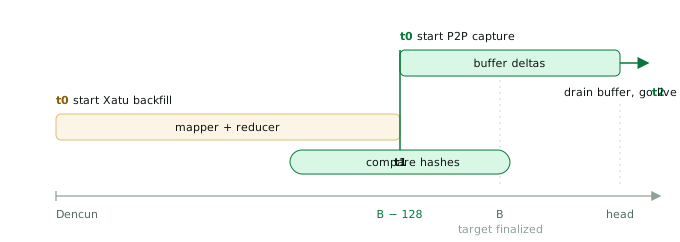
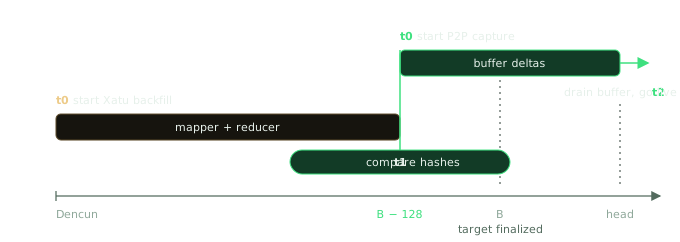
Example startup:
- t0: with target finalized block B, start P2P capture at B − 128 and the Xatu backfill at Dencun.
- t1: when the Xatu mapper and reducer reach B − 128, compare hashes over the overlap.
- t2: consume the buffered P2P deltas through the current head and switch the reducer to live.
Leani is tested independently through its API, SDK, RPC, and exported parity reports. The blobs.money repository owns the separate PostgreSQL transaction, range-reconciliation, deployment, and rollback concerns. Keep your application in sync walks through that reconciliation loop.
There are two integration paths:
- Compatibility RPC: point the current ethers/fetch and WebSocket code at the node’s local JSON-RPC. This proves method parity with minimal application change but still transports and transforms raw blocks in blobs.money.
- Native consumer: consume already-derived atomic blobs block events, commit application rows, and then advance the Leani-owned durable acknowledgement. Replays across that boundary are idempotent.
The second path is implemented and is the intended primary integration. The
first remains a compatibility, development, and emergency-fallback path until
production evidence supports a cutover. blobs.money currently carries a local
client; it should adopt the published @smart-byte/leani-sdk package once
their contracts are identical.
6. eth_config
The compatibility path can use eth_config to discover current/future blob
schedules. This traffic is tiny compared with blocks and receipts.
The node now maintains a versioned Mainnet schedule with exact activation timestamps and fork hashes, and serves the final EIP-7910 response locally. Future changes must be reconciled against protocol announcements and client chain specs before release. The native blobs processor carries the checked schedule in its versioned contract.
7. Reference validation and production cutover
Before production cutover, compare Leani output with a read-only export of the existing pipeline:
- compare every
blocksfield; - compare every blob transaction and sender;
- investigate current rows with missing/fallback receipts;
- compare rollup attribution;
- verify no gap at restart and source handoff;
- inject reorg fixtures;
- record source lag and finality.
Use these cutover stages:
- shadow writes to comparison tables;
- report differences without serving new data;
- make leani the historical backfill source;
- validate the local JSON-RPC compatibility path;
- run the native SDK stream into shadow tables;
- make the SDK stream the live primary; add an application-owned PostgreSQL adapter only if the integration proves it necessary;
- disable Alchemy block/receipt/head usage;
- keep emergency fallback explicit, metered, and off by default;
- remove
full_blocksonly in a separately approved recoverable migration.
8. Acceptance criteria
- Full Dencun-to-head backfill without paid RPC.
- Exact parity with the current formulas and schema over the agreed range, except the reserve-clamped blob fee and burns described in section 2.
- No permanent raw block/receipt storage.
- Live head lag normally within two blocks.
- Finalized cursor exposed separately.
- Restart, source outage, and shallow reorg tested.
- Native API, SDK, JSON-RPC, and blobs.money integration fixtures pass.
- Generic Bun SDK consumer can resume from a cursor and handle apply/undo/finality.
Production integration has separate acceptance criteria:
- production shadow parity;
- rollback tested;
- Alchemy CU attributable to block, receipt, and head monitoring reduced to zero in normal operation;
- remaining external requests itemized;
- any
full_blocksremoval explicitly approved and recoverable.
Built by Smart-Byte · Legal notice (Impressum) · Privacy